Bread can be an ingredient, a utensil and the meal itself. For food history, it also poses a trap: because bread is very old, it is easy to assume every familiar bread has remained unchanged. Man’oushe deserves a more precise story, one that pays attention to the people still making it.
What the evidence can tell us
The early bread remains from Jordan and the 2023 UNESCO inscription of Lebanese man’oushe document different things, separated by millennia. Neither proves an unbroken recipe.
Before the bakery, before farming
The Shubayqa research team used microscopic analysis to identify ancient bread remains. Their report describes the labour involved in processing wild cereals into food. The striking point is not that these people baked today’s pita, but that breadmaking could already demand several stages of work before cereal agriculture was established.[1]
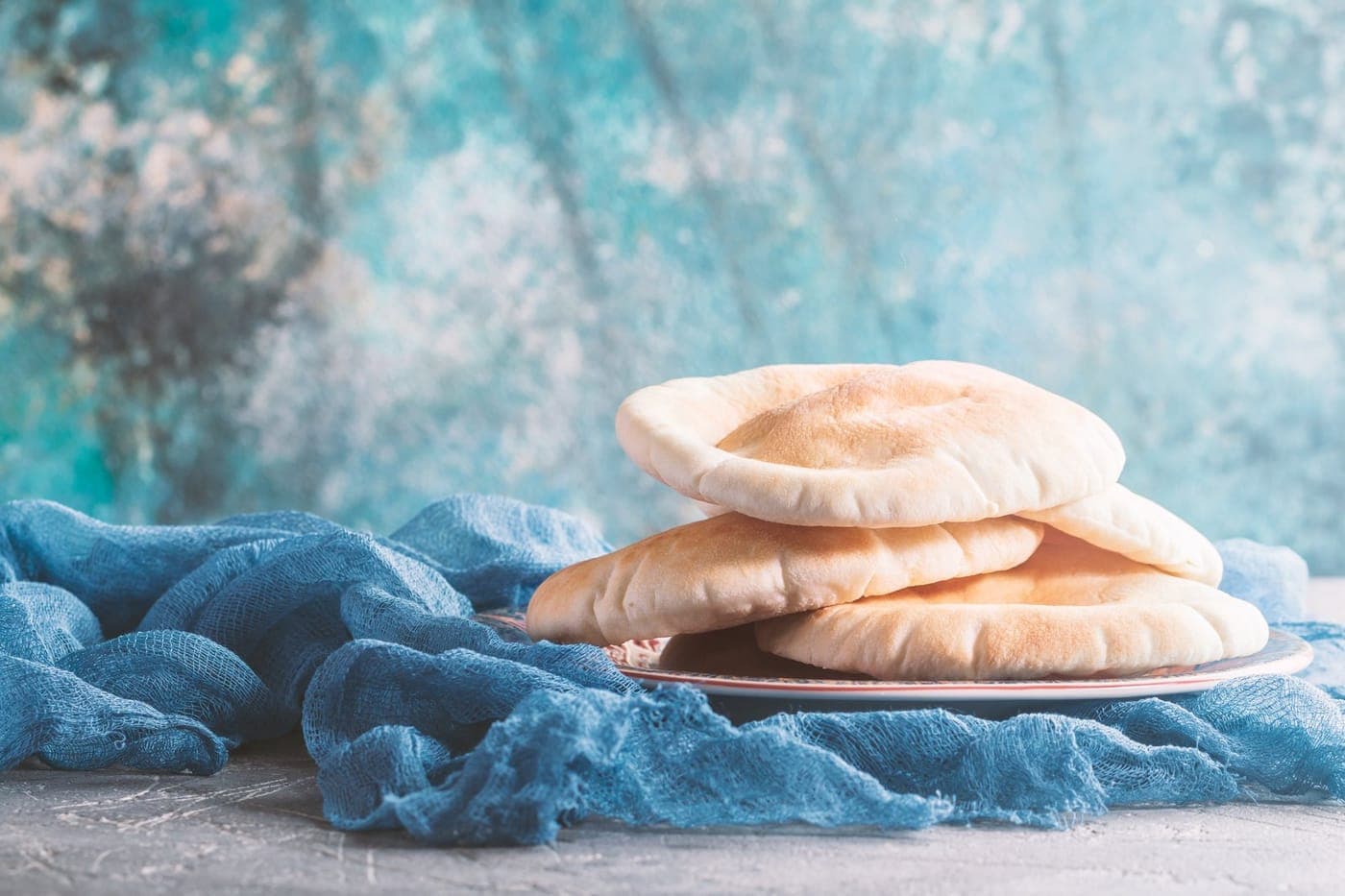
When imagining an earlier loaf, ask about the grain, its milling, the amount of water and the cooking surface. A circular shape alone tells us very little. “Flatbread” is a broad description, not a single recipe with one inventor.
What UNESCO recognised
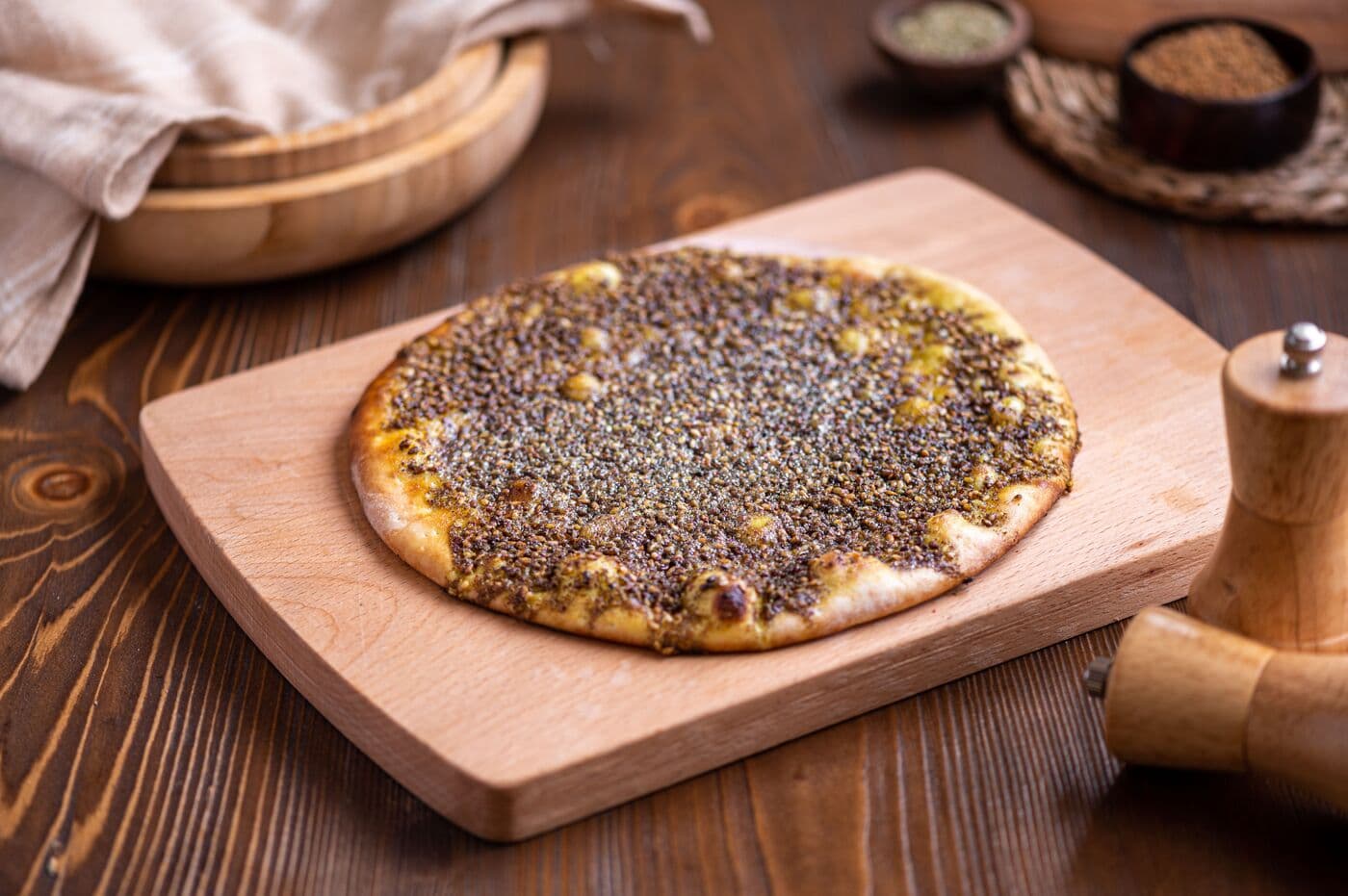
In 2023, UNESCO inscribed al-man’ouché as a Lebanese culinary practice. Its account describes dough indented with fingertips, a topping of herbs, sumac, sesame, salt and olive oil, and preparation in homes and small bakeries. It also records knowledge passed between generations and morning gatherings associated with its aroma.[2]
That recognition concerns living heritage: practice, transmission and social meaning. It is not an archaeological date of invention, a requirement that every baker use an identical formula, or an endorsement of this website. A tradition can be recognisable while its makers have room to differ.
Read the topping as a combination
For this breakfast, think of the herb, sesame, sour seasoning and oil as ingredients doing different work. The UNESCO description names thyme, sumac and toasted sesame; it also notes additions after baking, including labneh and fresh vegetables. That is a useful documented example, not a recipe that exhausts every use of the word za’atar.[2]
If you are recording a family blend, write down what went into it rather than only its name. Which herb was bought or gathered? Were the seeds toasted? Was salt already in the mixture? Was oil mixed in just before spreading? Those details make a family record reproducible without pretending to define everyone else’s breakfast.
A bakery is part of the story
It is worth documenting the place of production as carefully as the ingredient list. A home oven, a neighbourhood bakery and a large commercial line organise the work differently. In a future family interview, ask who prepared the dough, who carried it, who baked it and who got to eat first. Do not fill in those answers from a romantic picture of village life.
At the table, compare softness, the balance of topping to bread, and how the base has baked. Calling one version your favourite is perfectly reasonable. Calling it the only version ever made in Lebanon would need evidence far beyond a preference.
What to carry to the table
Man’oushe is worth preserving as a craft and a social practice, as well as a set of ingredients. Its present-day makers are part of its history.
Ask someone who remembers.
Was bread made at home, bought from a bakery or taken somewhere to be baked in your family’s routine?
Share a story or a correction ↗Sources & further reading
Historical evidence and contemporary cooking references serve different purposes. The notes below explain how each source was used. Sources checked 29 August 2026.
- Bread predates agriculture by 4,000 years ↗
University College London
Research team report on 14,400-year-old bread remains at Shubayqa 1 in Jordan.
- Al-Man’ouché, an emblematic culinary practice in Lebanon ↗
UNESCO Intangible Cultural Heritage
2023 inscription documenting living practice and transmission. It does not certify ancient origins.